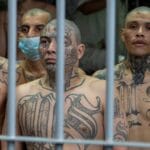
The United States has deported over 200 alleged Venezuelan gang members to a supermax prison in El Salvador, despite a federal judge’s ruling to block the removals. This controversial move has ignited legal debates and human rights concerns, as the Trump administration invokes a centuries-old law to justify its actions.
The Mass Deportations to El Salvador
On Sunday, El Salvadoran President Nayib Bukele confirmed the arrival of 238 members of the Venezuelan gang Tren de Aragua and 23 members of the MS-13 gang at the Terrorism Confinement Center (Cecot), a maximum-security prison. Videos shared by Bukele show the deportees shackled and escorted off planes by armed guards.
Neither the US nor El Salvador has disclosed details of the detainees’ criminal records or confirmed their alleged gang affiliations. This lack of transparency has raised concerns over due process and potential wrongful deportations. Critics argue that some of these individuals may not be involved in criminal activity but are being removed under broad accusations.
Legal Battle Over Deportations
The Trump administration justified these deportations under the Alien Enemies Act of 1798, a law designed to remove individuals from enemy nations during wartime. This law was last used during World War II to detain Japanese-American civilians. President Trump claimed that Tren de Aragua posed a national security threat and engaged in “irregular warfare” against the US.
However, a federal judge in Washington, DC, ruled against the administration’s use of the act and issued a 14-day halt to these deportations. The judge’s order was meant to prevent removals until further legal arguments could be heard. But by the time the ruling was issued, the flights carrying the deportees had already taken off. Judge James Boasberg then verbally ordered the planes to turn back, but this directive was not included in his written ruling.
The Department of Justice argued that the deportations were legally carried out because the individuals had already left US soil before the court’s written notice was filed. The administration maintains that it did not violate the judge’s order. The Justice Department has since appealed the ruling, stating that the judge’s order had “no lawful basis.” Meanwhile, the American Civil Liberties Union (ACLU) and other rights groups claim the court’s directive may have been deliberately ignored.
International Reactions and Human Rights Concerns
The Venezuelan government condemned the deportations, calling the move an unjust criminalization of Venezuelan migrants. Officials compared Trump’s actions to historical human rights violations, including slavery and the internment of Japanese-Americans during World War II. Amnesty International also criticized the deportations, calling them an example of discriminatory immigration policies based on sweeping and unverified allegations of gang membership.
El Salvador’s Cecot prison, where the deportees have been sent, has a controversial reputation. The maximum-security facility, which can hold up to 40,000 inmates, is a key part of President Bukele’s crackdown on organized crime. However, human rights organizations have accused the prison of mistreating inmates, denying them basic rights, and operating under inhumane conditions. Bukele stated that the deported individuals would be held for at least one year, with the possibility of extended detention.
The mass deportation signals a strengthening diplomatic relationship between the US and El Salvador. The arrangement to accept these deportees follows an offer Bukele made earlier this year, when he suggested his country could house US deportees as part of a broader security initiative.

Political and Immigration Policy Implications
The deportations align with Trump’s broader agenda to tighten immigration policies and remove undocumented migrants. Since taking office, he has signed multiple executive orders targeting illegal immigration. In January, he officially designated Tren de Aragua and MS-13 as foreign terrorist organizations.
Trump’s hardline stance on immigration was a central theme of his re-election campaign. He repeatedly promised to execute the largest deportation operation in US history, a promise that resonated with his voter base. While illegal border crossings have significantly decreased during his presidency, reports suggest Trump has been frustrated with the slow pace of deportations due to legal hurdles.
The use of the Alien Enemies Act to justify deportations raises constitutional questions. Under the US system of checks and balances, government agencies are expected to comply with federal court rulings. By invoking this rarely used law, the administration appears to be sidestepping traditional legal frameworks for deportation.
The Future of US Deportation Policies
The case is expected to set a precedent for future deportation cases under the Trump administration. If the courts uphold Trump’s use of the Alien Enemies Act, it could allow the government to deport non-citizens under broad national security claims, bypassing traditional immigration courts.
Meanwhile, the legal battle over these deportations is far from over. The Justice Department’s appeal could result in further judicial review, and advocacy groups are pushing for greater transparency in the deportation process.
The outcome of this case may also impact US relations with Latin American countries. Venezuela has already criticized the move as a violation of international law, while El Salvador appears to be benefiting from increased diplomatic and security cooperation with the US.